 How To Object

Was this really meaningful public consultation?
Concerns have been raised over the accessibility and conduct of a public consultation for a major holiday park proposed within the Lagan Valley Regional Park and Area of Outstanding Natural Beauty, after attendees reported no seating, no presentation or Q&A, insufficient comment forms and no information to take away. One elderly woman needed to borrow a wheelchair to reach the consultation room, while another using a Rollator reportedly had to leave because there was nowhere for her to sit.
A large number of local people attended the public consultation on 6 October for the proposed Ballyskeagh Holiday Park, opposite Bob Stewart’s, within the Lagan Valley Regional Park and Area of Outstanding Natural Beauty.
One attendee who remained for almost two hours estimated that close to 200 people passed through during that period. Others described a steady flow of people arriving and leaving throughout the event.
The turnout demonstrated very clearly the level of public interest in this proposal.
Unfortunately, the organisation of the event raised serious questions about whether local people were given a fair and meaningful opportunity to understand, scrutinise and comment upon what is being proposed.
A consultation people struggled to find out about
Before the event, Quarterlands Group had already raised concerns about the lack of publicity surrounding it.
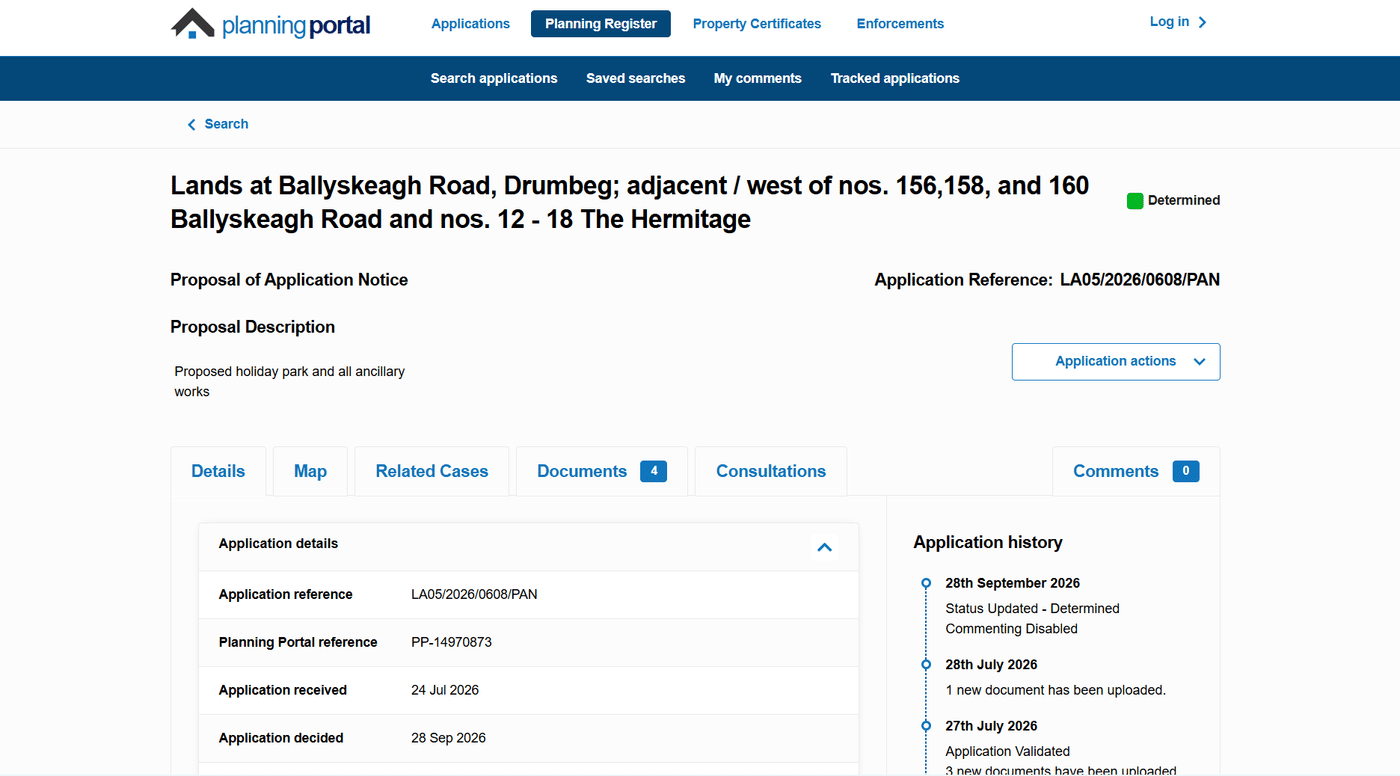
Despite the scale and sensitive location of the proposal, we could find no information about the consultation on the Lisburn & Castlereagh City Council planning portal, Council consultation pages, Council news pages, Lagan Valley Regional Park website or social media channels, or the usual press and local community information channels.
Quarterlands Group circulated details of the consultation ourselves to more than 70 elected representatives, community organisations, environmental contacts and groups across the area in an effort to ensure that people knew it was happening.
The detailed ten-page Bell Rolston consultation brochure appears to have become publicly available online only on 6 October, the day of the event itself.
Bell Rolston’s website now states that the consultation period runs from 6 October until 3 November 2026.
That raises an obvious question:
How could members of the public properly scrutinise a substantial proposal before attending its principal public event when the detailed information was not readily available to them beforehand?
What people actually encountered
The consultation display boards were headed “Gill Estate”, rather than “Ballyskeagh Holiday Park”. Gill Estate refers to the landowners, not the proposed development itself. This raises a further question about how clearly the proposal was identified and presented to the public.
The accounts Quarterlands Group has received from people who attended are remarkably consistent.
The consultation consisted principally of around ten large display boards in a relatively small room. With significant numbers attending, people were attempting to gather around the boards at the same time, making detailed examination of plans, elevations, photographs and text difficult.
There was no presentation explaining the proposal and no organised question-and-answer session.
There was also nothing substantive to take away.
No consultation brochure or printed copy of the proposal was available for people to take home and study. Attendees asking for information were instead repeatedly told words to the effect of:
“Download it from our website.”
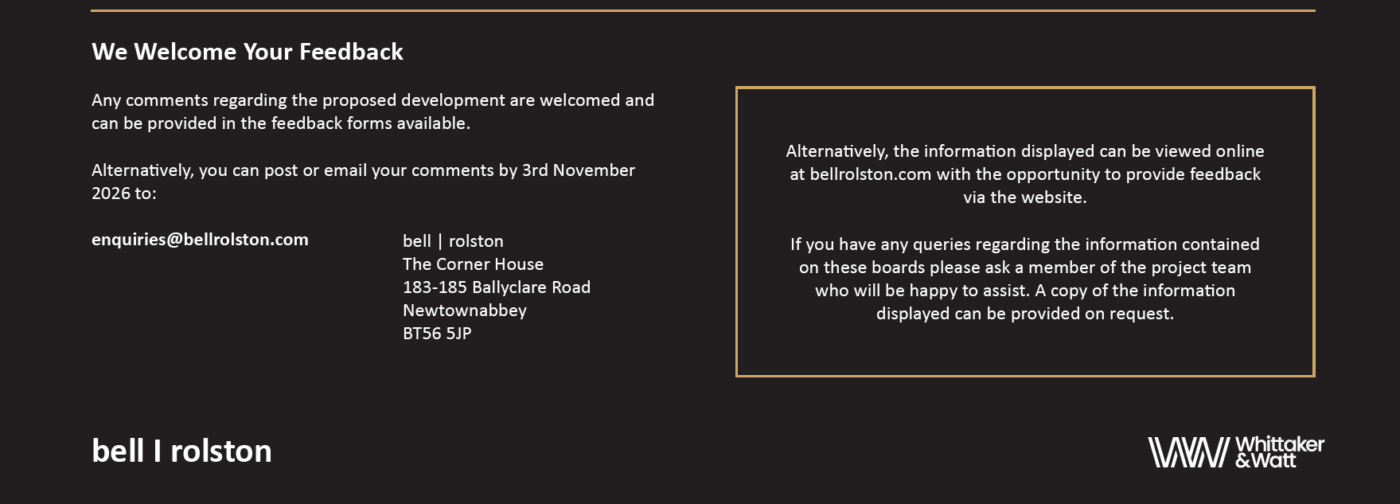
This is particularly difficult to understand because Bell Rolston’s own consultation material states: “A copy of the information displayed can be provided on request.”
see page 10
Yet attendees have told us that no copies were available to take away and that they were instead directed online.
As one attendee subsequently commented, that rather assumes everybody has access to a printer.
Not everyone has reliable internet access, is comfortable examining detailed planning documents online or has the equipment to print a ten-page brochure containing plans and drawings.
That matters when the information being consulted upon is sufficiently complex that it cannot reasonably be absorbed while standing in a crowded room looking at an A1 display board.
Accessibility was not theoretical
Perhaps the most concerning accounts we have received concern attendees who struggled to access and use the consultation room.
One elderly attendee needed to borrow a wheelchair simply to reach the consultation room because of its distance from the main entrance.
Her daughter told us:
“We had to borrow a wheelchair for her as the room was miles from the front door.”
Once inside, being seated in the wheelchair meant that she was unable properly to see much of the material displayed on the boards.
We have also received a report of a woman using a Rollator who struggled to reach the room and found that there was nowhere for her to sit down. She was effectively unable to remain at the consultation and had to leave again.
There was no seating provided in the consultation room for those who could not comfortably stand while examining the material.
This turns what might otherwise be dismissed as an inconvenience into a genuine accessibility concern.
A public consultation must be capable of being accessed meaningfully by the community it is intended to consult, including older people and people with disabilities or limited mobility.
Getting through the door is only part of accessibility. A person must also have a reasonable opportunity to see and understand the information once they are there.
Commenting wasn’t straightforward either
There were also problems with the arrangements for recording public responses.
The supply of consultation/comment sheets was inadequate for the numbers attending.
One attendee reported repeatedly seeing additional sheets being taken or torn from ring binders as people asked for them. People were not routinely directed towards the forms or clearly told how they could formally record their views.
Attendance recording itself also appears to have been inconsistent, with numerous people apparently entering and leaving without registering.
That is significant if attendance figures are subsequently relied upon in the Pre-Application Community Consultation report accompanying any eventual planning application.
And there is a great deal here to understand
Questions were also raised about the proposed pond. One attendee reports being told by a representative that its details could change, leaving uncertainty about precisely what members of the public were being asked to consider.
This is not a proposal for a handful of modest holiday cabins. See the current documentation.
The material describes a substantial tourism development incorporating 17 accommodation buildings, together with associated facilities and infrastructure.
Some of the proposed buildings are approximately 9 metres high.
Questions remain about the scale, appearance and practical function of the accommodation; traffic and access; parking; wastewater and drainage; landscape and visual impact; biodiversity; lighting; noise; and the proposed four outdoor padel courts.
Attendees have also raised the absence of meaningful information at the event about the potential noise generated by four outdoor padel courts.
These are significant matters for a development proposed within the Lagan Valley Regional Park an Area of Outstanding Natural Beauty, close to existing homes and an environmentally sensitive landscape.
They cannot reasonably be assessed by glancing at display boards in a crowded room.
“They’re not houses”
One exchange at the consultation was particularly notable.
When concern was raised about what appeared to be 17 substantial residential-style buildings in an area not zoned for housing, a representative reportedly responded that they were not houses because they were not intended for permanent residence.
When pressed further about what distinguished these buildings from houses, the representative reportedly explained that the proposed accommodation could only be occupied for ten months of the year.
That raises further questions about the intended use of the buildings, how any occupancy restriction would operate and how it would be enforced. A restriction on permanent residence does not, in itself, answer questions about the scale, character or planning impact of the development.
But whether they are described as “units”, “holiday accommodation”, “holiday homes” or part of a “tourism development” does not remove the need to examine what is physically being proposed.
The important questions are much simpler:
What are these buildings? How large and how tall are they? What facilities will they contain? How many people can occupy them? How intensively can they be used? And what impact will 17 of them, together with 11 camping pitches and the rest of the development, have on this protected landscape and its community?
Those are all matters of planning substance, not terminology.
What does the law require?
The statutory Pre-Application Community Consultation process exists so that consultation takes place before a major planning application is submitted.
The detailed requirements are contained in the Planning (Development Management) Regulations (Northern Ireland) 2015.
The statutory process includes a public event at which members of the public can make comments on the proposed development, together with advance newspaper publicity.
The Planning (Miscellaneous Amendments) Regulations (Northern Ireland) 2025 introduced additional online consultation requirements, including maintaining a website containing information about the proposed development and providing a means for members of the public to comment during the required consultation period.
But consultation should not simply be about technically satisfying individual procedural steps.
Its purpose is to give the community a meaningful opportunity to understand what is proposed and make representations before the planning application is finalised.
That is the test against which this consultation should now be considered.
Consultation or box-ticking?
What is striking about 6 October is that the problem certainly wasn’t a lack of public interest.
People turned up in considerable numbers despite the limited publicity.
What they encountered was a small, uncomfortably warm and crowded room, around ten display boards, no presentation, no organised Q&A, no seating, inadequate supplies of comment sheets and no detailed information to take home.
People who wanted to study the proposal further were repeatedly directed online.
One elderly attendee had to borrow a wheelchair to make the journey from the entrance to the consultation room and then found herself unable properly to see the information on display.
Another woman using a Rollator reportedly struggled to reach the room, found nowhere to sit and had to leave again.
And all of this concerned a substantial development within the Lagan Valley Regional Park an AONB.
The question therefore has to be asked:
Did this provide the community with a meaningful opportunity to understand and comment upon the proposal or did it simply fulfil the requirement to hold a public consultation event?
A formal complaint is now being made to Lisburn & Castlereagh City Council, asking it to consider whether the consultation complied adequately with the requirements and purpose of the statutory Pre-Application Community Consultation process and whether the public event should be correctly publicised and re-run properly.
That would not prevent the proposal progressing.
It would simply give the public what the consultation process is supposed to provide in the first place:
A reasonable opportunity to see the information, understand what is being proposed, ask questions, consider the details and make an informed response.
For a development of this scale, in one of Northern Ireland’s most valued protected landscapes, that does not seem an unreasonable thing to ask.
Click here if you wish to email Bell Rolston
Click here if you wish to email Lisburn and Castlereagh City Council